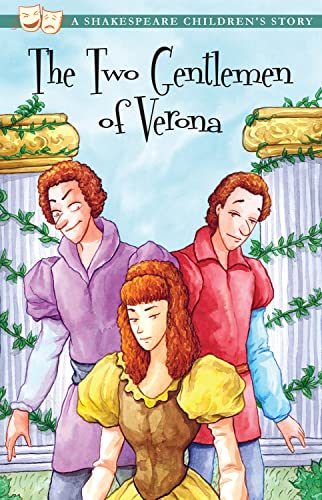
The Two Gentlemen of Verona is a comedy by William Shakespeare, believed to have been written in 1590 or 1591. It is considered by some to be Shakespeare's first play.The play deals with the themes of friendship and infidelity, the conflict between friendship and love, and the foolish behaviour of people in love. The highlight of the play is considered by some to be Launce, the clownish servant of Proteus, and his dog Crab, to whom "the most scene-stealing non-speaking role in the canon" has been attributed.1595THE TWO GENTLEMEN OF VERONAby William ShakespeareDRAMATIS PERSONAE DUKE OF MILAN, father to Silvia VALENTINE, one of the two gentlemen PROTEUS, " " " " " ANTONIO, father to Proteus THURIO, a foolish rival to Valentine EGLAMOUR, agent for Silvia in her escape SPEED, a clownish servant to Valentine LAUNCE, the like to Proteus PANTHINO, servant to Antonio HOST, where Julia lodges in Milan OUTLAWS, with Valentine JULIA, a lady of Verona, beloved of Proteus SILVIA, the Duke's daughter, beloved of Valentine LUCETTA, waiting-woman to Julia SERVANTS MUSICIANSSCENE: Verona; Milan; the frontiers of MantuaACT I. SCENE I.Verona. An open placeEnter VALENTINE and PROTEUS VALENTINE. Cease to persuade, my loving Proteus: Home-keeping youth have ever homely wits. Were't not affection chains thy tender days To the sweet glances of thy honour'd love, I rather would entreat thy company To see the wonders of the world abroad, Than, living dully sluggardiz'd at home, Wear out thy youth with shapeless idleness. But since thou lov'st, love still, and thrive therein, Even as I would, when I to love begin. PROTEUS. Wilt thou be gone? Sweet Valentine, adieu! Think on thy Proteus, when thou haply seest Some rare noteworthy object in thy travel. Wish me partaker in thy happiness When thou dost meet good hap; and in thy danger, If ever danger do environ thee, Commend thy grievance to my holy prayers, For I will be thy headsman, Valentine. VALENTINE. And on a love-book pray for my success? PROTEUS. Upon some book I love I'll pray for thee. VALENTINE. That's on some shallow story of deep love: How young Leander cross'd the Hellespont. PROTEUS. That's a deep story of a deeper love; For he was more than over shoes in love. VALENTINE. 'Tis true; for you are over boots in love, And yet you never swum the Hellespont. PROTEUS. Over the boots! Nay, give me not the boots. VALENTINE. No, I will not, for it boots thee not. PROTEUS. What? VALENTINE. To be in love- where scorn is bought with groans, Coy looks with heart-sore sighs, one fading moment's mirth With twenty watchful, weary, tedious nights; If haply won, perhaps a hapless gain; If lost, why then a grievous labour won; However, but a folly bought with wit, Or else a wit by folly vanquished. PROTEUS. So, by your circumstance, you call me fool. VALENTINE. So, by your circumstance, I fear you'll prove. PROTEUS. 'Tis love you cavil at; I am not Love. VALENTINE. Love is your master, for he masters you; And he that is so yoked by a fool, Methinks, should not be chronicled for wise. PROTEUS. Yet writers say, as in the sweetest bud The eating canker dwells, so eating love Inhabits in the finest wits of all. VALENTINE. And writers say, as the most forward bud Is eaten by the canker ere it blow, Even so by love the young and tender wit Is turn'd to folly, blasting in the bud, Losing his verdure even in the prime, And all the fair effects of future hopes. But wherefore waste I time to counsel the That art a votary to fond desire? Once more adieu. My father at the road Expects my coming, there to see me shipp'd. PROTEUS. And thither will I bring thee, Valentine. VALENTINE. Sweet Proteus, no; now let us take our leave.